
A film that screens at 11:59 p.m. is bound to draw the eye. Although NAGA, a Netflix film out of Saudi Arabia, would be inconspicuous otherwise—a title among other titles on the TIFF programme, it certainly found the right crowd as part of a Midnight Madness screening at the Royal Alexandra Theatre on a Tuesday.
An unassuming Meshal Aljaser (dir. Arabian Alien, Is Sumiyati Going to Hell?) walked out onto the stage, conceding that he didn’t expect such a large audience and making a point to say, in a Jordan Peele way, that he would classify NAGA as a comedy instead of a thriller. It’s true that there were more than a couple of jokes.
It’s unusual to see a film that isn’t like anything else you’ve seen before. Not to say that NAGA doesn’t look or sound (remarkably) like a big-budget, box-office smash like Uncut Gems. But the uncanniness running through it, the unlikelihood of its making and release to a mainstream, international audience (it was programmed at TIFF as a rough cut), in conjunction with the exact sum of its artistic parts, the gazing back into the abyss of a Western audience, all make the film something that evades description.
Adwa Bader is at the forefront when it comes to the success of the picture, earning her a TIFF Rising Star award. An LA-based Saudi renaissance woman, Bader makes a stunning breakout performance as Sara, a deadpan young woman who takes off with her boyfriend on a psychedelic trip into the desert under the guise of a shopping trip that her father will pick her up from at 9 p.m. To hear the narrative described as simple might not be intuitive, because it’s non-linear and embellished by a sound design that makes Transformers seem quaint. But the container for the 111-minute movie is as easily understood as Inception and Ulysses: a clock ticking, the events of one particular day.
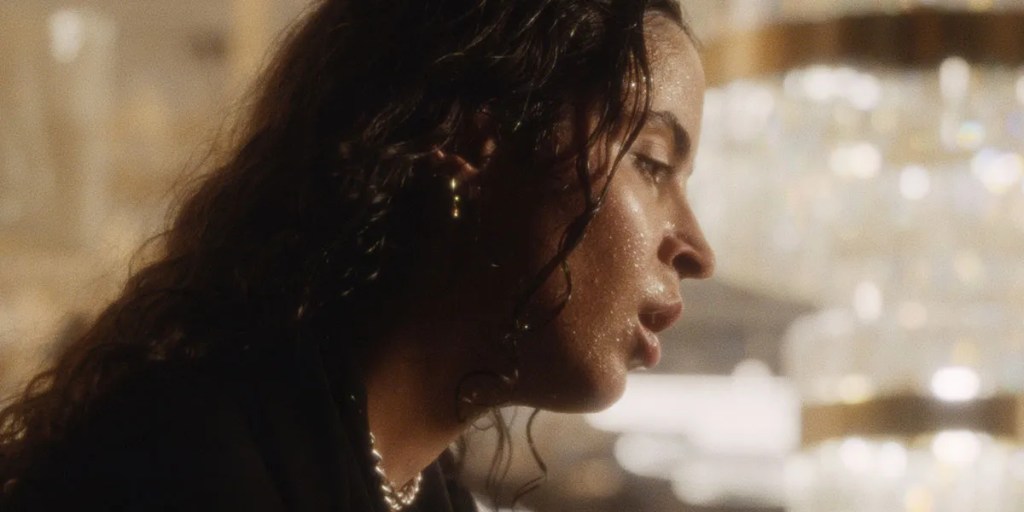
NAGA, with its immediate visual appeal and quick dialogue (I thought of White Teeth, hysterical realism, and also magical realism), is laden with symbols. Every film is an ode to a place, but to witness the levity, freedom and absence of mystery with which Aljaser treats Riyadh’s street-level conversation was refreshing. And it was as if the film could anticipate where every laugh would be, glossing over the belly laughs and turning each potential for ignorance into a greater cause for satire.
The shiny appeal of a cup of drug-infused tea, little mountains on tin foil, the luxury assumed by a chandelier (or a whole window of them) serves as a simple visual cue that invites speculation about what the film is gesturing at on a political level. Also, camels. Lots of them, in varying levels of aliveness and decay. It’s rare to have a film call to mind animal studies, but that’s what I was thinking about as I considered the parallels between human and animal life, the abdication of responsibility in a lawless, stateless reality (or fever dream), the cruelty of humans.
Sara moves through the day in different styles of dress—her hair is uncovered and covered, she uses a hair tie. There is the moment she stops in front of her gate to put on her headscarf before darting out to whoop her little brother’s ass. It’s not hard to picture how universal forces enter the strainer of quotidien life in Saudi Arabia, where as common knowledge goes, women were not legally allowed to drive motor vehicles until 2018. Where, perhaps, restraint and duplicity exist in poetry and freedom exists in one of its forms in the cars that line the streets after a win by the national football team.
Wayfinding is another powerful theme in NAGA, where at the almost-end of the film, Sara drives a motorcycle from the dunes ensconced in darkness back to urban streets by recalling the instructions given through a half-cracked window by a stranger. The billboards, mosques, and monuments trained in the view of one’s Google Map are not only the most mundane parts of life but can save your life. Are they beautiful? Sinister? It depends what time of day it is. Those of us privileged to travel have had “relatable” moments where a phone dies, a charger is needed—the specific type of charger that fits a later model of phone. A reliance on the luxury of time, dumb luck, and a will to live is something we all have in common.
NAGA is Aljaser’s first feature-length film. Based in Los Angeles, where he studied screenwriting, Aljaser garnered a large YouTube following with the release of several short films that also deal in divertive and aesthetically ambiguous ways with his birthplace. For Aljaser to make his feature debut at TIFF is truly exciting to see. A release date for NAGA is yet to be announced by Netflix.
 Faithful Correspondence
Leave a comment