
In the word for youth in Mandarin, there is also the word for spring. I did the algebra in my head watching the opening credits of Youth (Spring), director Wang Bing’s 3.5-hour film, the first chapter of a three-part documentary about the lives of young garment workers in Zhili, China. Add an hour and a half to to the length and I think an eat break or pee break might be legally required by the Employment Standards Act in Ontario, if it were work to watch a film.
The director himself wasn’t there at the screening, which could have owed to any number of reasons—visa or scheduling issues, production on another project, maybe he wasn’t in the mood to see people trickle out as time went on. Maybe it’s Maybelline.
Zhili is a small township in Zhejiang province, close to Hangzhou, a port city, former outpost of the Silk Road, and jewel of the Song Dynasty. In Zhili, about 300,000 migrant workers are employed in workshops that produce mostly children’s clothing that demand grueling hours and highly skilled labour for little pay. Most of the workers in the documentary are from Anhui, another southeastern province bifurcated by the Yangtze river and home to Huangshan (“Yellow Mountain”) and agricultural fields, stately homes made of concrete.
At the Cannes Film Festival earlier this year where Youth (Spring) premiered, Wang was asked a series of strange but artful questions about two of his films that were selected. The other was a shorter film called Man in Black. When Wang was asked what he felt the differences were between his generation of youth and the youth of today, he answered that he thought they experienced pretty much the same conditions of life, which I think is a courageous answer, but maybe that’s really what he thinks and maybe that’s even the case. He added that today’s youth live under more stress.
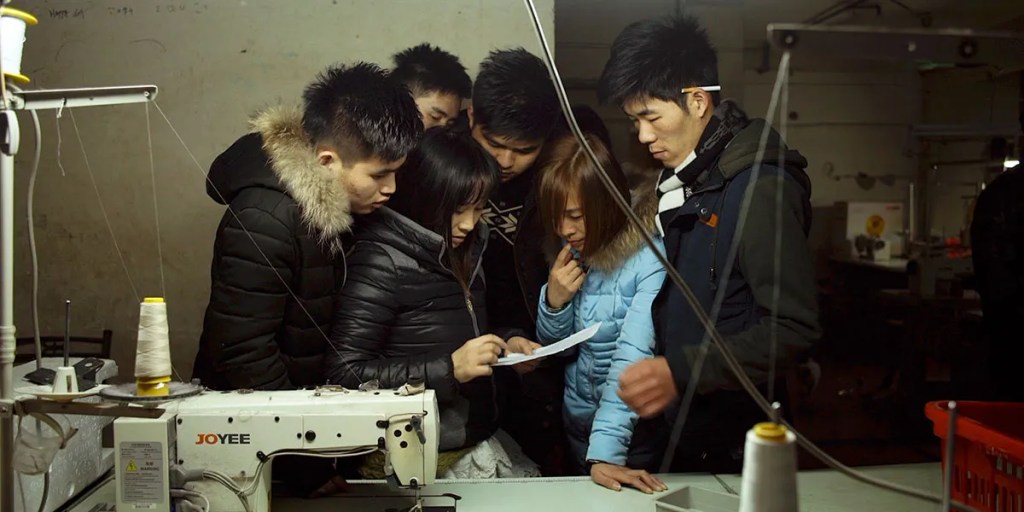
When I think of the classic Chinese novels The Water Margin and Dream of the Red Chamber, which I do because of the many personages in Youth (Spring), I think of the novelistic impulse to resolve most everything about people who are introduced. In a documentary, this is not a requirement. One is reminded that a young man can get on a bus with his friend, never to be seen again. As the footage rolls, we are introduced to more and more migrants who are around the same age, 19 to 21. More fall away, or are sent to get abortions. Some ponder their own youthfulness and talk about getting married to a person of their choosing. 30 is old.
Because art imitates life, or vice versa, the very act of putting a camera down, or holding it to your chest, turning it on, and eavesdropping on a conversation will get you a meaningful shot. Meaning will sprout from the ears of the footage. It’s inevitable, and the metaphors don’t even ask permission to appear, they just do when you watch it back. Unintentionality is beautiful. It attracts envy because it didn’t even ask to be born, yet it’s out in the world, like a peach pit sunning itself on the sidewalk in the middle of the day. Then again, what use is beauty in a garment workshop on Happiness Road? Is it there for dramatic irony or is it appreciated? I wonder if certain people in the film know they are beautiful.
It might be surprising to think of beauty in such a polluted environment. There is no society in Zhili, one angry resident points out early in the film. People freely litter the floors of their dormitories and the rainy streets outside with whatever they are holding in their hands or in their mouths, because they are too tired to have possessions, and this is not their home. I remember hearing a commercial on the radio years ago when I was visiting Beijing: “When water is dirty, what will we use to wash it?” was the kicker. Why worry at this point? I assume the answer would be.
As Wang has elucidated, freedom in documentary is proportional to how much time the filmmaker has to make it. Without at least a few years in tow, you produce a frenzied, stressful film. Time builds trust, by its own virtue, needing very little else. But being a good person doesn’t hurt the odds. Youth (Spring) condenses 2,600 hours of footage, I assume digital. Wang’s longest documentary, 铁西区: West of the Tracks, is considered an epic at 9 hours long, and some people in the audience apparently had seen it.
Looking at the workers in the film is like looking at the Mona Lisa: she’s smiling, is she happy? The young people laugh and jest, the cultural differences between East and West are so apparent. But happiness is not the preferred currency, and being jovial is seen as bringing no value. When people speak of “family” in corporate life, the term dulls in comparison to the family that really is forged in these workshops. There’s a way difficult things are said, and imagine what’s not. In a film that reveals such intimate moments, one certainty is that many more such moments are deliberately not shown. Phone calls to one’s children are tender, phone calls to one’s mother are private. There’s the showers, what the inside of the bathrooms look like.

Throughout the documentary we see a strange balance of power. An elderly man who owns a workshop can defy the wishes of a room full of able-bodied workers. Is this what the law does in practice? Negotiations for rates of pay for different types of work are convoluted and obfuscated, even by the people involved in and affected by them. Workers jostle for the rate that best suits them, sometimes undercutting others who are slower. Some people shop around for better rates and treatment since there are so many workshops looking for people with the same skills. But this turns out to be a futile exercise as the prices are set by a modern day cartel.
At some point in the advent of capitalism, workers were separated from the means of production. This is visually represented by the owner of one of the garment workshops cleaning and testing his machinery while trying to quiet a group of discontented workers, who have nothing to care for but themselves. Garment making and the requisite skill needed to make clothing were removed from their place inside the home and placed in factories and workshops. These activities accelerated during the Industrial Revolution and, despite the hype around new technology writ large, has changed remarkably little since then. The entire system, which includes the owners of these workshops, tries to keep pace with the whims of capitalistic fervour, the appetite for new styles and batches of clothing each season.
The starts of spring, not the throes of winter, mark the New Year in parts of the world. And it is the time in China when migrant workers go home to visit family, reunite with loved ones, sleep in their own beds. You start to wonder: will they ever get to go home? You start to track the time of year by what they’re wearing. The fashionable clothes they wear, which they can afford just as they can afford to eat fast food every day, for every meal. Toward the end the workers are wearing short sleeves, so you wonder if winter has passed. If winter has passed isn’t it springtime? On the walls of one of the shots someone has inscribed in black marker: Spring, Summer, Fall, Winter. They’ve scribbled the words vertically in three sets, just like I would if I were practicing the remembrance of how characters are written. Seasons of change when the only constant is the hum of machines and the music that plays over speakers. Communal music, ubiquitous and unrelenting.
Not a moment’s peace, one young worker says, freeing him from the work that never ends, from how he gets picked on by others. But also not a moment of privacy. In some shots the young men and women are wearing their own earphones, listening to whatever music they want. In a choiceless life a person looks past choice. It’s probably a romantic pop song much like the one that’s often blaring, prodding fast hands to work faster. Quality control works itself, as it becomes harder to do a bad job the more work is done. Skill accumulates, slack is for beginners.
A note about love: I don’t think the film deals much in it. Love isn’t love just because someone says it is. But there is desire, there is intimacy. From beginning to end the young workers are shown touching each other, making jokes about perversion and harassment. There is the desire to be touched, the recoil from a person’s touch, all in the same shot. This cues us to the fact that there is nothing these young people can do for leisure but be proximate to each other. Closer and closer. Sometimes they have to be held back.
I thought I might lose my mind sitting there in the theatre. At one point my eyes sensitized to the theatre darkening even more and what I thought were shadows lengthening. I was also feeling antsy because there was another overlapping screening, at 7:00 p.m., of Chen Kaige’s Farewell My Concubine. What better way to spend the day than to compare the works of two contemporary Chinese filmmakers, both considered vanguards.
I sat in the bottom row in preparation to leave a little early to stand in the rush line. But the question was how early? I decided as the picture went on that it would be better to watch the film in its entirety and arrive at half past the hour so as to avoid the line altogether. There was bound to be at least one unoccupied seat. But as time passed I realized it would be physically impossible to watch another three-hour film immediately after. I’ve seen Farewell My Concubine before, by the way it is also about toil under a different regime. The film has just been restored and I can see it another time at another venue, or even on my laptop again. But aside from the disrespect I thought would be evident by my leaving the theatre in the middle of the trappings of these young people’s lives, I didn’t know where I’d see their faces again.
As the end credits rolled, and as we were walking out delirious, with oils on our cheeks and haze in our brains, I overheard two women talking about the film. One said something along the lines of it needing character development, forgetting or not knowing that the people in the film are not characters. “You can’t just turn on the camera, you have to do a little work,” she opined. I thought among other things that this woman had wasted three-and-a-half hours of her life. I’m ruthless in leaving this here, as it’s one of those arcane, incantatory maledictions that shouldn’t be repeated. But like the film, I’m unsure where it will be seen again and by whom.
 Faithful Correspondence
Leave a comment