• Two films that cure boredom

    I’ve been a little bored lately, circling the complex where I live like a prisoner of my own making. Except ‘my own’ is a little heavy handed a remark; it is a collective kind of incarceration that besieges us in an array of consequences. Even with restrictions loosening in public life, I find myself staying with the same boxed-in routines, that seem more airy than they were months ago. I looked out the window the other day and saw that the fence that separates our homes from the train tracks had been vandalized. It was cleaned, by whatever means possible, and then graffitied again. I keep looking to see if the cycle repeats.

    Two films recently woke me from what feels like a long slumber: Olivier Assayas’s Irma Vep, and Michael Haneke’s The Piano Teacher. In both cases, viewer discretion is advised – which is the least of their appeal.

    Both films are, visually speaking, about looking: what happens when you examine the contours of someone’s face — looking at what they are looking at — closely. In the opening scene of Irma Vep, Maggie Cheung walks into a French film production company’s offices without a common language, looking around as we do for a clue. A clue is not what we get in this film, which is nevertheless about creation, re-creation, and reflexivity. Maggie is cast as a version of herself – an actress from Hong Kong who is to be the star of a remake of the silent 1915 French film, Les Vampires. A French film within a French film, in which intellectualism is almost parodied. In the end, however, an argument seems to be made for its necessity, or at least its fruitfulness.
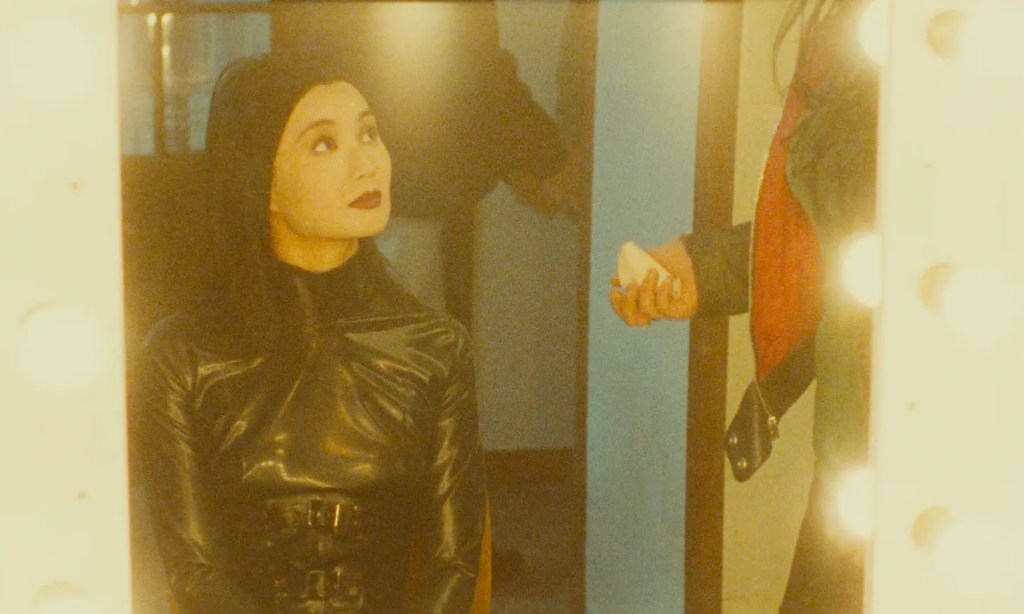
    To focus on what the film means is to overlook what it makes us see; its limns of the banalities of filmmaking that produce great scenes. Maggie’s task, according to the film’s off-kilter director, René, is to “be herself,” something that is hardly possible in a black latex, skin-tight costume and powdered face. Her performance throughout, as herself, are strong: she is self-conscious, exchanging pleasantries and controlling the level of intimacy she feels with characters, a girl at a party who isn’t in on the joke, or able to speak the language. Others fawn over her. It may as well be a movie about stardom, a movie about stars that don’t align.

    In The Piano Teacher, the person with the most power is scrutinized from the position of someone who doesn’t sit in the glare of their scrutiny. You wish you knew how to play piano so you could be grateful for the fact you were not playing. The camera is smart: it looks at you, looking at the characters, looking at each other. Isabelle Hupert’s character, Erika Kohut, is cold and calculating as she is sympathetic. We see her peer at female skaters being forced off the ice by a group of male hockey players. Her lower lip trembles and we let down our guard. But the film as a whole is one where you would prefer to look away.
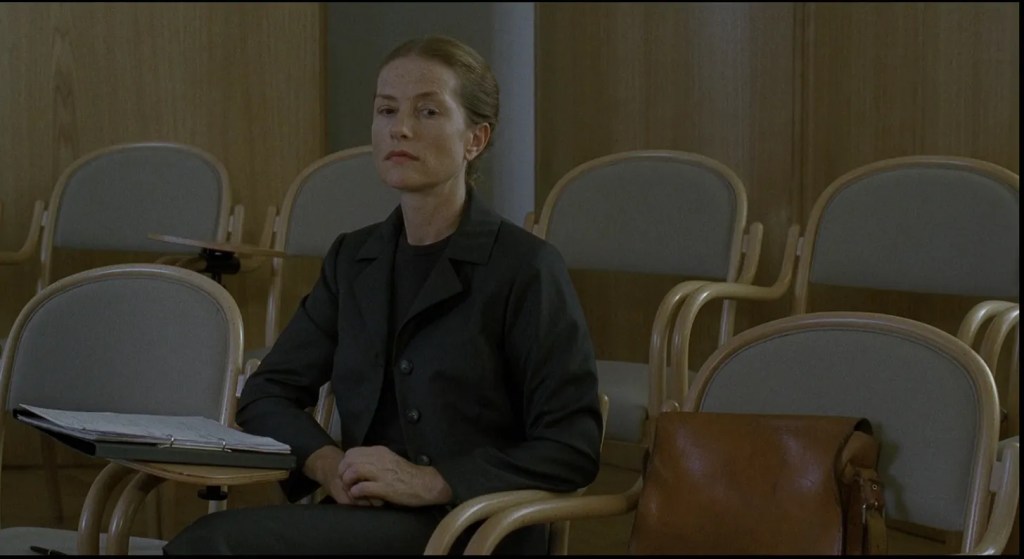
    In the last scene, one of the most powerful cinematic moments I hold in my memory, there is a break in understanding. We lunge after Erika’s feelings in this moment of resonance and dissonance. Why is this emotion—whatever version of it makes her human in our eyes—off limits to us in a way that refurbishes our interest in her motivations? Or is it not a matter of choice? A violent act toward oneself draws sympathy in a way that we cannot fully comprehend, but we go with it, and her, into the dark contours of the city. The doors are there, they swing open. She leaves.

  • Lonely on a dance floor

    I was thinking about how I should respond should someone ask me where I was at the end of the decade. The satisfying version would be, “in the Amazon,” which is partially true, but not very precise. Amazônas is the name of the province in Brazil which encompasses the rainforest; Amazonas is also the name of the analogous departments in Colombia, Peru, and Venezuela. It also would not be accurate to say so, as I was only at the edge of this part of the Amazon River, not the forest, known for “as encontras das aguas,” where black and brown waters meet. For some reason, as I was thinking about the question, I pictured myself on a dance floor somewhere undiscerning and without a shape, not alone but invariably by myself. There must have been some vague music playing in the background – as not a connossieur of great music (the type who likes anything but not everything) – I could not decide which soundtrack should burn in the echoes of this distilled fantasy. The picture was half full, as a glass. I was in the bottom third of the frame walking out of it, while at the top there was some purple tinged resonance of an air of greed, or lust. Something that would captivate an audience.

    But isn’t it the morning that matters? I woke the next morning without an alarm, and got up at around 7:10, made coffee and eggs in the shared kitchen downstairs, and put on my repellent to cover the scars of bites. I had “lost,” or dropped, or had stolen, my debit card the day before, which in the way that things are lost gives way to guilt and mourning that are totally unreasonable and not brief. I feel that I am better at being more concise with it, able to shed with lighter effort the mourning like a skin, of things lost which lingered and which were held for so long that they began to accumulate meaning. It is a wonder artificial intelligence seeks to become more human; and it is no wonder this is an easy feat, easier in all the ways it is possible to transform without a purpose, will, or saying.

    This is too morose for New Year’s Day, and I apologize. At least there is the smell of coffee, the oils and the aroma that could accompany almost any edible fruit. As for the dancing, I must admit I can’t. It is not simply a matter of trying – which I’m used to – and not, I think, a question of talent. It is sheer intuition: that other institution which connects parts of the brain to the body, the muscle, the movement. 

    I am reminded of what the novelist Ottessa Moshfegh mentioned in passing on a podcast, where she was telling an anecdote she had heard which goes something like this: When you are writing a story, there is going to be a breakthrough moment where clarity sets in and the story becomes lucid. But the experience is like being trapped in a room with no visible door. Although trapped may be a tinge too forceful, since you are there of your own will. (Something like that other joke, about being trapped in a haunted house in a dream.) You only know that there is a trap door, but you don’t know where. You know it is possible to find a way, but the way does not appear until it does. I have found this maddening and terrifying since I became aware of it, the picture of a room with square beige walls lingered in my mind. So, it is possible for me to one day spontaneously know how to dance, but until the day arrives the thought is moot, a complete waste of feeling. This is an insane inducing madness. It is easier to write without thinking of such things.

  • Beau Travail

    Almost midway through watching Claire Denis’ Beau Travail, my mother asked me to help her cut her hair, which I did dutifully, not before inspecting the new linen on the carpet of our living room. The movie had put me in a reflective mood, and made me think about how much our lives can be like films. How our dialogue, curt and unintentional, can be molded into moments of clarity and intention. The artful take of me cutting her hair would be akin to the beautifully rendered images of Denis’ 1999 film, based loosely on a novella by Herman Melville.

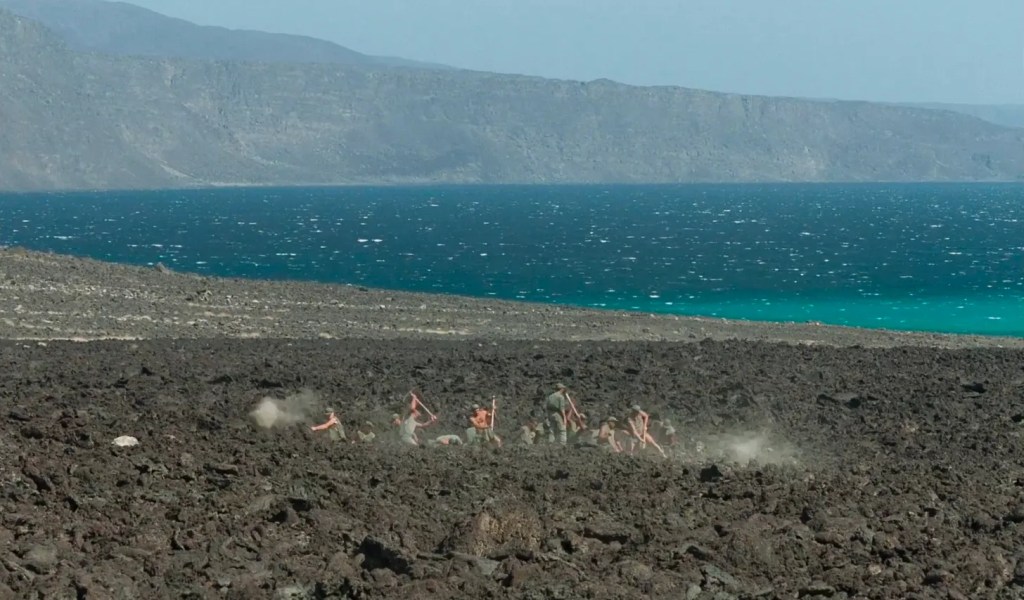
    In the film, sixteen officers are stationed in the arid, desolate landscape of Djibouti, rocky terrain surrounded by blue, clairvoyant water. A sergeant, Galoup, develops an obsession with another officer, Sentain, who is a young newly-arrived legionnaire. Galoup tries to stymie Sentain’s success to impress the commanding officer who takes an interest in Sentain but pays little attention to Galoup. In between the shots of hardened masculinity set against the impossible backdrop, there are delicate moments of feminine care work and domesticity among the men. (The men iron their uniforms; a man hangs up washed undergarments waving in the wind.)

    The film begins and ends with dancing; in the beginning it takes place in the physical, consumable world, and in the end it is unclear whether it is in an afterlife, a dream or a vision. Denis prioritizes physicality above all else in Beau Travail, showing the sinews of soldiers’ muscles while they perform their daily exercises as she does women’s shapely forms while dancing. She feminizes and elegizes the men in long takes of their faces, with an opera-like soundtrack in the background. She establishes and undermines the idea of empire, French colonial power, that is set up to malign a country’s inhabitants.

    When Galoup first sees Sentain, he describes him as thin and not fitting of being an officer. “I felt something vague and menacing take hold of me,” he says. On the other hand, he admires his commandant “without knowing why,” and admits the man never confided in him or cared about him. Galoup says he feels a rage brimming inside him, a jealousy that cannot be contained. Later on, when the commander asks Sentain if he gets along with his parents, he reveals that he was found in a staircase. The commander responds that at least it’s a ‘belle trouvée,” a parallel with “beau travail.”

    The film is an exercise in labour, or its equivalent in yearning, whether it is for a dance, for a man, or for home. The camp is set up in an arid plateau with children and their parents watching. It seems as though there is no need for it, and its reason for existing does not come into the picture. Yet there is a particular need, or want, in each hoist of the body, each swim, each thrust of the arm. In the end, the tragic fate of Sentain is caused by an overreaction, another brimming of rage, by Galoup, who knocks a canteen of water out of his hands while Sentain tries to aid a fellow soldier. The soldier is being punished for abandoning his post, resigned to digging in the hard, rocky ground, a hole of unknown depth.

    Beau Travail begins with the writing of a memoir, a hapless if not overused device, to describe events in the past tense, from a point of view that is already withered, less accurate and reliable. Movies that begin with the act of remembering include Persepolis (2007), a coming of age story of a girl in the midst of the Iranian revolution, and An Education (2009), the memoir of a girl who is seduced by an older man, and Forrest Gump (1994), in whose recollection there lie many hilarious outtakes and revivals of pop culture. Denis’ film, with its wistful logic, makes for Sunday night viewing, a night balanced on the edge of morning, in the dance halls of someone’s basement or in the mind’s eye.

  • Night Journey

    “When I think of a Taeko Kōno story,” writes Gabe Habash in a Paris Review article, “I picture a glass filling with liquid.” He’s writing about Kōno’s short story collection, Toddler Hunting and Other Stories, translated by Lucy North and republished by New Directions in 2018. “As the story reaches its end, the glass is filled to the brim,” he writes. “But in the final moment, the liquid spills over the side and lands on the surface below. That new plane, something that we hadn’t even considered before, is now—surprisingly yet inevitably—stained.”

    From time to time, I revisit Habash’s review, if not for that picture of the glass and its liquid, then for the way it calculates the peculiar, unfinished endings of the stories in Toddler Hunting. The first story, “Night Journey,” is illuminated by what is later referred to in another story as an “unusual excitement.” There’s the familiarity of a couple bantering back and forth about what to do on a starry night, and then leaving the relative safety of their home to check up on their friends, who are due to visit but don’t show up. It’s suspense that fills this glass, and a sense of an ominous ending until it arrives: “Fukuko realized that she’d been in a particular mood for some time now, a mood that would keep her walking beside Murao into the night, walking on and on until they became the perpetrators—or the victims—of some unpredictable crime.”

    Habash’s review is strong for all the characteristics of a good review: descriptive, observant, and committed to unravelling what exactly is at the core of the stories taken as a collection, and one story in particular. “How could these last seven pages of night wandering be so frightening?” he asks. “It’s because we don’t get an answer for why this is happening. … The original goal of the story—to spend time with Utako and Saeki and, we assume, switch partners—has been disrupted, forcing Fukuko and Murao in a different direction. But what are they hoping to find?”

    The language of the stories is so remarkably strange and candid at the same time, that it reads as if it must have always been translated. It must have changed hands but been of its own volition at the same time. The wandering tenses of the story seem perfect extensions of the moods they convey. The simple past tense will slide into the past perfect, and then the subjunctive, in sentences that are sharp as much as they elide into winding staircases. The stories each have their own “present,” in which events unfold willingly and without much fuss, and a more objective standpoint from which the events are observed, often by a narrator or an interior voice of a main character.

    In “Theater,” for example, this ironic aloofness casts a shadow over the seemingly mundane events of the story in which a woman becomes fascinated with a hunchback and his beautiful wife. “Hideko soon became a frequent visitor at the house of the hunchback and his wife. She devoted herself to becoming their friend. She had never met a real man or woman before, she relized. Compared to them, anyone else was just a generic human being.” In the title story, “Toddler Hunting,” Akiko, an “unmarried woman past thirty” who detests young girls and adores little boys, confronts her disturbing obsessions: “Little boys inhabited such an infinitely wholesome world—Akiko always had the impression that it restored and purified her. … Little boys went along with her in her games—sometimes they almost seemed to egg her on.”

    Habash credits Kōno with writing with the intent to subvert the traditional idea that wives in Japan were submissive to their husbands. Indeed, in many of the stories, there is the unspoken sense that masculine power is being subverted and reconfigured in eerie ways. There is an eroticism underlying some of the stories, such as “Toddler Hunting” and “Night Journey,” in which the narrator knows something that the characters don’t about themselves, something which is revealed to the reader in due time and usually involves their malleable sexuality. Many of the protagonists are unmarried women, no doubt also a sign of rebellion in the times the stories were written, between 1961 and 1969. As Habash writes, “In Kōno’s stories, in which sex, power, and desire are all intertwined, the desire of the protagonists, all of them women, is so powerful that it topples their lives and their carefully constructed circumstances.”

  • Open Justice

    *This essay was written during the summer, in what felt like a different pandemic.

    “People in mourning tend to use euphemism,” writes Zadie Smith in her book of essays, Feel Free. “The most melancholy of all the euphemisms: ‘The new normal.’ It’s the new normal, I think, as a beloved pear tree, half drowned, loses its grip on the earth and falls over.” This vertiginous ‘falling over’ is perhaps all the more so in the midst of a pandemic that could not stop mass protests in the defence of Black livelihoods, and that could not still minimize the chance of major climate catastrophe. And the new normal bobs strangely on uncharted waters.

    In Open Justice, an online exhibition first launched at the start of all this in March and which ran through July 18, the concept of normalcy—or its illusion—is also the axel upon which curator Ronald Rose-Antoinette considers six moving image works. “To unthink justice or how we habitually construe justice as a return to a default (i.e. violent) norm which, in fact, never took precedence is a difficult but necessary task,” he writes.

    The work of an exhibition is referential: each work must relate to another, no matter how disparate they are in the subjects and emotions they consider. In Open Justice, reflexivity ripples through each work itself, whose elements are untied to the earth, like loose silt, or a tooth unsettled in the mouth. In ALTIPLANO, a meticulously arranged work of 35 mm film and sound design, topographies of the Chilean desert are overlaid upon each other in quick sequence, creating a disorienting arrangement of change. In Gosila, Beatriz Santiago Muñoz, order attempts to be restored following a hurricane in a tender portrait of rural life and its remnants in Puerto Rico.

    Open Justice considers normalcy in a different way than the kind we’re perhaps most inclined to discuss in this unusually long moment—the works deal with subject matters grounded in the earth, and around it are themes of environmental change, extraction, migration, the making and unmaking of history, biology. The exhibition considers, very explicitly, the notion of “catastrophe” in environmental terms. The six featured films were released on the cusp of the global restrictions brought on by COVID-19, and so the online format was perhaps incidental, and not a necessity. Yet, in the context of such a massive global shift in ways of doing and relating to each other, the works taken together do incur a layer of new meaning.

    It is interesting, for instance, to consider the way the exhibition considers the archive, at the same time that it begins to shoulder some of the responsibility of digital archival. In Filipa César’s The Embassy, a hand lifts each page of a photo album to reveal the images taken by a Portuguese colonist, who wielded power over the West African country Guinea-Bissau. The film itself is an act of archival, resisting the documentary power of the original images to reveal a new counter-memory. The films taken as a whole in the exhibition seem to do more than what is on the screen, striving toward permanence in the estuaries of a temporary online exhibition.

    The statement from the curator, Rose-Antoinette, puts this in perspective: “This exhibition aims to constitute a textu(r)al, durational and accessible documentation of a variety of practices nurtured by emerging and established filmmakers from around the world. Together these images offer a poetic twist on anticolonial aesthetics seeking to turn, over and over again, — underlining the complexity of the term “catastrophe”: a coming to an end anterior to all stasis — what is unjustly and dangerously figured as irreversible.”

  • Mulholland Dr.

    “I just wanted to come here,” says the man in the “Diner Scene” of Mulholland Drive, if you look it up on YouTube. “Winkie’s?” says another man incredulously. So begins a great film sequence in one of David Lynch’s most storied films.

    This summer, I liked a playlist of the movie’s soundtrack on Spotify and played the track by Angelo Badalamenti on loop as I made my daily suburban walk, along a main street, through a small meadow with a tennis court I looked at each day, and through a trail beside a neighbourhood called Creditpointe, with an ‘e’ at the end feminizing it aptly and uncannily. The soundtrack’s slinky irony made for satisfying listening, even if somewhat unsettling. But that was the goal, anyway.

    The Diner Scene, with its abrupt and lonesome scare, is one of several well-known scenes laden with hints, signs, symbols and references to be sifted through and analyzed by moviewatchers and Lynch fanatics. Mulholland Dr., stylized as such, is one of the greatest films to be made — the greatest, according to a BBC poll of film critics in 2016, followed by Wong Kar Wai’s In the Mood for Love in second place, and trailed by Richard Linklater’s Boyhood in fifth.

    “Every element in cinema is important, and music is one element, and I always say that the music has to marry to the picture,” says Lynch in conversation with David Stratton, in Australia in 2015. Indeed, the soundtrack to Mulholland Dr. is as varied and piecemeal as the film itself, at times jingly and sombre, by turns ironic and operatic. The film reads as many dreams stitched together, forming a linear-like progression of merry and miserable scenes that lock out the real in favour of the plausible, not altogether impossible.

    “It’s a mysterious road,” Lynch says of Mulholland Drive, particularly at night. It has views of the Hollywood Hills just as it has ahead of it a long, winding path. Naomi Watts, who stars as Betty, has said of it, “Mulholland Drive was a particular road that I remember when I was down, down, down on my luck, and remember thinking, this day is going too bad and this has been a succession of really bad days. I could just do a quick turn and just drive off this cliff. But there are times you could drive around and it’s a smooth ride, and it’s the opposite of that.”

    The many interpretations of the film seem to converge on one likelihood, which is that Betty Elms is the dream version of Diane Selwyn, and encounters in her dream Rita — who in “real life” is Camilla Rhodes — a lover and alter ego who suffers from amnesia after a car accident. The two encounter other characters in the course of auditioning for a part (Betty), searching for her identity (Rita), and attending a performance at a late night club and a dinner party late in the movie (both). The film is said to explore stardom and putrefication, a “love story in the city of dreams,” as Lynch himself has characterized it.

    The film doesn’t lack for comedic moments, alongside the bizarre, like the infamous “cowboy scene,” in which a director for a big name studio, Adam Kesher, is interrogated by a dreamlike character who instructs him to cast the woman in the photograph he was shown earlier in the day. “You will see me one more time if you do good. You will see me two more times if you do bad.” In another scene, Kesher pours pink paint over his lover’s jewellery box after catching her in bed with another man.

    When I watch Mulholland Dr., a sense of uncanny washes over me, and whatever delights the movie brings also washes a sense of dread and abject terror. Why are we drawn to such imagery, and what can be the comfort in sharing such a dream? The film is not moralistic, or does not seem to impart a lesson, but the fate of Diane Selwyn leaves the viewer confused as to why reality is as harsh as it is, and why sheer ambition should give way to such strife. The film seems as if it shouldn’t be as elegaic as it is, nor as funny or crude, but it is. It is a film with a long, winding arch and many characters who are cast and recast in strange acts and are not, ultimately, understood.

  • Common objects, uncommon light

    I remember seeing Josef Sudek’s gelatin silver prints for the first time at the National Gallery in Ottawa, still an important place to me, for its expanse more so than any other feature. The large, oblong windows made for great viewing, and wondering, and made me feel safe in spite of the fact of windows: that they let light in just as they let light out. It was winter, and I walked the lit path home on a foggy evening.

    Sudek’s photographs call to mind a stranger’s brush against your coat on the bus. His way of seeing reminds me of a framing I used to use, at my teacher’s encouragement, in ninth grade: “It can be seen that…” And his still life, of an egg, triggers the memory of my mother telling me how my grandfather, in a nursing home, gave my uncle and his wife a tea egg that he had saved from that morning.

    Born on March 17 in 1896, Sudek is best known for his photographs of still lifes and interiors of Prague, many of which were taken from his studio. The image, “The Window of My Studio,” which can be viewed online at the New Orlean’s Museum of Art, recalls the fact that the German philsopher Immanuel Kant, born a century and a half earlier, never left the outskirts of his hometown of Königsberg. He enjoyed his solitary walk each day. “Rain or shine, it had to be taken. He went alone, for he wanted to breathe through his nose all the way, with his mouth closed, which he believed to be excellent for the body. The company of friends would have obliged him to open his mouth to speak.” writes John Merrick for Verso.

    Sudek photographed everyday objects in different lights, on different days, at different angles, an example of which could be, “Untitled (pear on crooked plate),” or “Glasses and Eggs.” He believed in the way images could be transferred through diararistic ambition and a curiosity about the way light refracts. His is an intimate collection of publishable unpublishings, that deserve to be seen even if they were not meant to be. Other works, landscapes like Paesaggio, take a wider, panoramic and more global view of intimacy. They stay grounded in his point of view while taking on a stony silence that is estranged from the energy of his other works. In his still lifes, taking into consideration his quotidien subjects, Sudek’s photographs are varied and more experimental than they even appear at first glance. He deeply abides the interior monologues that exist to distinguish what is inside, between and outside the window, the fog that settles on it as if on the camera lens.