
• Precious elements

    I was so pleased to speak with Iranian-Canadian artist Parastoo Anoushahpour for Peripheral Review last year, about her film with Faraz Anoushahpour and Ryan Ferko, entitled The Time That Separates Us. I’m excited to share the piece with you, which you can read in full here. I also recently viewed the group’s newest exhibition at Mercer Union in Toronto, called Lovers’ Wind, which I highly recommend that you see if you’re in the area. It’s on until March 23, 2024.
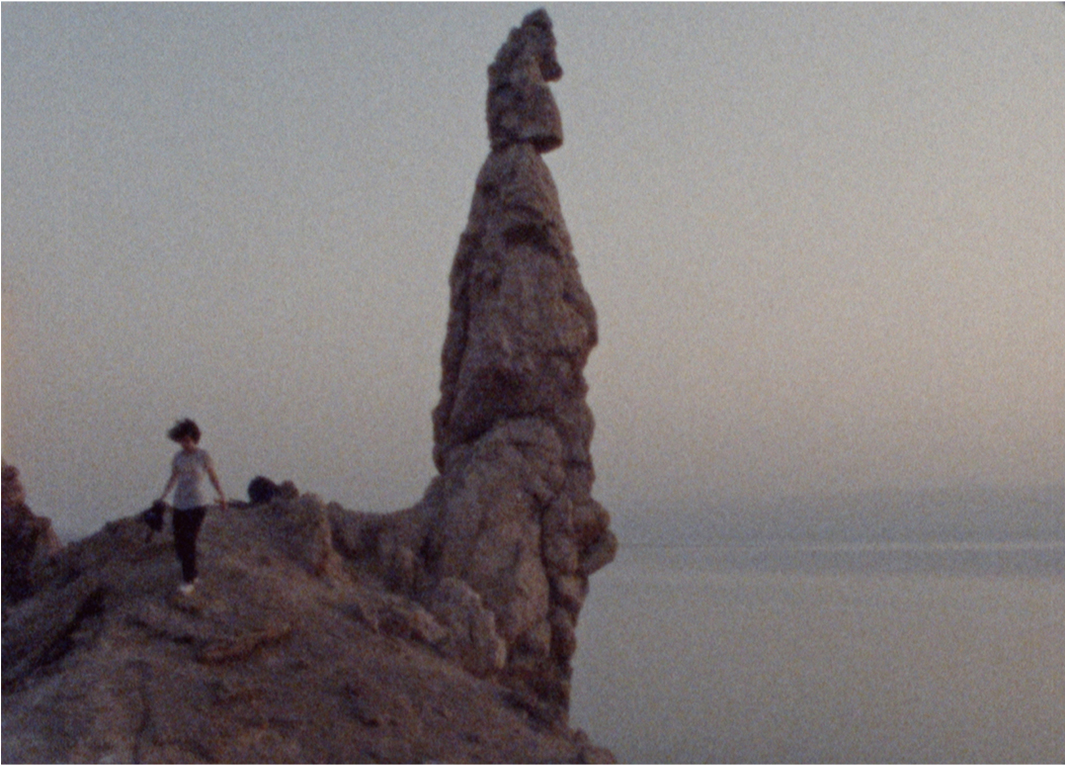
    Still from The Time That Separates Us (2022), courtesy of the artist.

    I can’t say for certain why Parastoo Anoushahpour’s recent film The Time That Separates Us (2022) absorbed my attentions. In the spring, I found myself on the edge of the University of Toronto’s St. George campus in Innis Town Hall, a cinema and lecture theatre. I was compelled to take out my notebook in the dark to record some thoughts: Story of the Ammonites / Lot’s daughters—The key to taking a selfie is to take just one—’Valle’–Yes—There–English—Not everything is meant to be written—All memories become important—A light hand / a Heavy Land.

    As part of a 2023 Images Festival screening series called Passages, Anoushahpour’s film was screened alongside the works of Iranian filmmakers Naghmeh Abbasi, Siavash Yazdanmehr, and Rojin Shafiei. Collectively, these works spoke to each other in Arabic and Farsi, between modes and metaphors. I tried to understand the language between them. Shot in Jordan and Palestine, The Time That Separates Us is grounded in the land and the mythologies around Lot’s Wife and the Pillar of Salt. In the film, an intimacy of thoughtful and honest intentions is foregrounded in the exploration of the film’s subjectivities in a heavily mediated landscape.

    A couple of weeks after the screening, during a trip to New York City, I reached out to Anoushahpour to ask if she would be open to talking about her work. The Toronto-based filmmaker and artist spoke with me from Athens, Greece, where she was at the time. Our conversation meandered between ideas I had sent her in an email, and we spoke about elements of craft and process—not in a way that would explain certain artistic decisions or meanings, but to more insightfully navigate why I came away feeling so touched by her work. 

    Anqi Shen: My immediate response to your film was that its strength lay in the attention given to the unreliability of narrative. I found the graininess at the beginning really satisfying, it just felt so aesthetically beautiful. If there was one word I would use to describe the film, it would probably be “unprecious.” Is that how you see it as well?

    Parastoo Anoushahpour: No, that isn’t a word that comes to mind, but I really like it. I think in some ways, some elements of it are being treated to feel unprecious as opposed to how they’re usually treated—certain narratives that have power and are very rooted in the culture and the landscape—they’re untouchable somehow, and I guess unprecious and untouchable can switch.

    AS: I think what I mean by “unprecious” is that it didn’t seem that everything was pristinely put together. The film came across as personal, and I’m not saying craft wasn’t involved…

    PA: Maybe it’s “unprecious” as opposed to that element of control that comes with craft and goes with a certain kind of narrative. There is a level of giving up control in a way that things come together. It takes you out, it breaks the thing it is trying to say. But I like “unprecious.” For me personally, it was a lot about control, and also even practicing a level of looseness that I don’t usually do in my work with my collective—with Faraz Anoushahpour and Ryan Ferko—we’ve been working together for almost a decade.

    Because of the content and form I was working with for this film, it was important to try to find the balance in keeping the responsibility or authority in stringing these versions of narratives along, even though a lot of the texts and the voices that write some of those texts are people I collaborated with over a long time and they’re very much involved in guiding the direction. Those relationships are important to me, so it was about finding a way to keep that precious, and let that guide the image.

    […]
    Read the full interview at Peripheral Review.

  • Open Justice

    *This essay was written during the summer, in what felt like a different pandemic.

    “People in mourning tend to use euphemism,” writes Zadie Smith in her book of essays, Feel Free. “The most melancholy of all the euphemisms: ‘The new normal.’ It’s the new normal, I think, as a beloved pear tree, half drowned, loses its grip on the earth and falls over.” This vertiginous ‘falling over’ is perhaps all the more so in the midst of a pandemic that could not stop mass protests in the defence of Black livelihoods, and that could not still minimize the chance of major climate catastrophe. And the new normal bobs strangely on uncharted waters.

    In Open Justice, an online exhibition first launched at the start of all this in March and which ran through July 18, the concept of normalcy—or its illusion—is also the axel upon which curator Ronald Rose-Antoinette considers six moving image works. “To unthink justice or how we habitually construe justice as a return to a default (i.e. violent) norm which, in fact, never took precedence is a difficult but necessary task,” he writes.

    The work of an exhibition is referential: each work must relate to another, no matter how disparate they are in the subjects and emotions they consider. In Open Justice, reflexivity ripples through each work itself, whose elements are untied to the earth, like loose silt, or a tooth unsettled in the mouth. In ALTIPLANO, a meticulously arranged work of 35 mm film and sound design, topographies of the Chilean desert are overlaid upon each other in quick sequence, creating a disorienting arrangement of change. In Gosila, Beatriz Santiago Muñoz, order attempts to be restored following a hurricane in a tender portrait of rural life and its remnants in Puerto Rico.

    Open Justice considers normalcy in a different way than the kind we’re perhaps most inclined to discuss in this unusually long moment—the works deal with subject matters grounded in the earth, and around it are themes of environmental change, extraction, migration, the making and unmaking of history, biology. The exhibition considers, very explicitly, the notion of “catastrophe” in environmental terms. The six featured films were released on the cusp of the global restrictions brought on by COVID-19, and so the online format was perhaps incidental, and not a necessity. Yet, in the context of such a massive global shift in ways of doing and relating to each other, the works taken together do incur a layer of new meaning.

    It is interesting, for instance, to consider the way the exhibition considers the archive, at the same time that it begins to shoulder some of the responsibility of digital archival. In Filipa César’s The Embassy, a hand lifts each page of a photo album to reveal the images taken by a Portuguese colonist, who wielded power over the West African country Guinea-Bissau. The film itself is an act of archival, resisting the documentary power of the original images to reveal a new counter-memory. The films taken as a whole in the exhibition seem to do more than what is on the screen, striving toward permanence in the estuaries of a temporary online exhibition.

    The statement from the curator, Rose-Antoinette, puts this in perspective: “This exhibition aims to constitute a textu(r)al, durational and accessible documentation of a variety of practices nurtured by emerging and established filmmakers from around the world. Together these images offer a poetic twist on anticolonial aesthetics seeking to turn, over and over again, — underlining the complexity of the term “catastrophe”: a coming to an end anterior to all stasis — what is unjustly and dangerously figured as irreversible.”

  • Common objects, uncommon light

    I remember seeing Josef Sudek’s gelatin silver prints for the first time at the National Gallery in Ottawa, still an important place to me, for its expanse more so than any other feature. The large, oblong windows made for great viewing, and wondering, and made me feel safe in spite of the fact of windows: that they let light in just as they let light out. It was winter, and I walked the lit path home on a foggy evening.

    Sudek’s photographs call to mind a stranger’s brush against your coat on the bus. His way of seeing reminds me of a framing I used to use, at my teacher’s encouragement, in ninth grade: “It can be seen that…” And his still life, of an egg, triggers the memory of my mother telling me how my grandfather, in a nursing home, gave my uncle and his wife a tea egg that he had saved from that morning.

    Born on March 17 in 1896, Sudek is best known for his photographs of still lifes and interiors of Prague, many of which were taken from his studio. The image, “The Window of My Studio,” which can be viewed online at the New Orlean’s Museum of Art, recalls the fact that the German philsopher Immanuel Kant, born a century and a half earlier, never left the outskirts of his hometown of Königsberg. He enjoyed his solitary walk each day. “Rain or shine, it had to be taken. He went alone, for he wanted to breathe through his nose all the way, with his mouth closed, which he believed to be excellent for the body. The company of friends would have obliged him to open his mouth to speak.” writes John Merrick for Verso.

    Sudek photographed everyday objects in different lights, on different days, at different angles, an example of which could be, “Untitled (pear on crooked plate),” or “Glasses and Eggs.” He believed in the way images could be transferred through diararistic ambition and a curiosity about the way light refracts. His is an intimate collection of publishable unpublishings, that deserve to be seen even if they were not meant to be. Other works, landscapes like Paesaggio, take a wider, panoramic and more global view of intimacy. They stay grounded in his point of view while taking on a stony silence that is estranged from the energy of his other works. In his still lifes, taking into consideration his quotidien subjects, Sudek’s photographs are varied and more experimental than they even appear at first glance. He deeply abides the interior monologues that exist to distinguish what is inside, between and outside the window, the fog that settles on it as if on the camera lens.